writing
A Look at the Simple LRU Cache Implementation in MMKVMMKV 中的简单 LRU 缓存实现解析
· Performance & internals
Translated from Chinese — .
On this page
LRU (Least recently used) is a cache update strategy: when the number of cached items reaches the maximum capacity, or some condition is met, the least recently used element is evicted. Not long ago WeChat open-sourced a client-side Key-Value storage library MMKV https://github.com/Tencent/MMKV, which contains a very compact LRU cache implementation (the LRUCache class).
Introduction to How LRUCache Works
- Use a linked list to record all elements (key and value).
- Use a hash table to record the key and its position in the linked list, so we can quickly tell whether an element is already present.
- When adding a new element, insert it at the head of the linked list.
- When accessing an element, move it to the head of the linked list.
- If the count exceeds the maximum capacity, delete the tail of the linked list.
Below is the code with comments.
The MMKV Implementation
I’ll just paste the code here — I believe it’s easy to understand after one read-through.
// 链表
#import <list>
// 无序map
#import <unordered_map>

// key和value类型
template <typename Key_t, typename Value_t>
class LRUCache {
    // 最大元素个数
    size_t m_capacity;
    // 链表存储pair
    std::list<std::pair<Key_t, Value_t>> m_list;
    // 记录key和指向链表的iterator(迭代器,类似指针)
    std::unordered_map<Key_t, typename decltype(m_list)::iterator> m_map;

public:
    LRUCache(size_t capacity) : m_capacity(capacity) {}

    // 当前占用的大小
    size_t size() const { return m_map.size(); }

    // 空间最大
    size_t capacity() const { return m_capacity; }

    // 是否包含某个key
    bool contains(const Key_t &key) const { return m_map.find(key) != m_map.end(); }

    // 清空
    void clear() {
        m_list.clear();
        m_map.clear();
    }

    // 添加
    void insert(const Key_t &key, const Value_t &value) {
        // 是否已经添加过key
        auto itr = m_map.find(key);
        if (itr != m_map.end()) {
            // 添加过
            // 则把这个元素移动到链表的最开始(iter->second移动到begin)
            m_list.splice(m_list.begin(), m_list, itr->second);
            // 覆盖key的新value
            itr->second->second = value;
        } else {
            // 是否满了
            if (m_map.size() == m_capacity) {
                // 满了(超过了设定的最大空间)
                // 移除掉链表的最后一项
                // 跟进最后一个key移除掉map中的项
                m_map.erase(m_list.back().first);
                // 移除掉链表的最后一项
                m_list.pop_back();
            }

            // 没有满
            // 链表最开始添加
            m_list.push_front(std::make_pair(key, value));
            // 加入map
            m_map.insert(std::make_pair(key, m_list.begin()));
        }
    }

    // 获取
    Value_t *get(const Key_t &key) {
        // 查找
        auto itr = m_map.find(key);
        if (itr != m_map.end()) {
            // 找到了
            // 移动找到的项目到链表最开始(iter->second存储了指向当前项目在链表中的迭代器)
            m_list.splice(m_list.begin(), m_list, itr->second);
            return &itr->second->second;
        }
        return nullptr;
    }

    // 遍历每一项
    void forEach(std::function<void(Key_t&,Value_t&)> callback){
        for(auto & item : m_list){
            callback(item.first,item.second);
        }
    }
};
Adding a Print Method
Above I added a helper method forEach to print all elements.
    void forEach(std::function<void(Key_t&,Value_t&)> callback){
        for(auto & item : m_list){
            callback(item.first,item.second);
        }
    }
Just pass in a lambda expression and you can print.
Test Example
        LRUCache<string, int> cache(5);
        cache.insert("a",1);
        cache.insert("b",2);
        cache.insert("c",3);
        cache.insert("d",4);
        cache.insert("e",5);

        cache.forEach([](string& key,int& value){
            NSLog(@"%s - %d",key.c_str(),value);
        });

        NSLog(@">> after insert 6");

        cache.insert("f",6);

        cache.forEach([](string& key,int& value){
            NSLog(@"%s - %d",key.c_str(),value);
        });

        NSLog(@">> after get d");

        cache.get("d");

        cache.forEach([](string& key,int& value){
            NSLog(@"%s - %d",key.c_str(),value);
        });
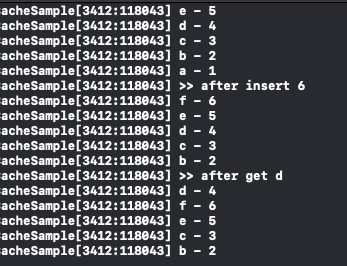
The output is as follows:
Code
- LRUCache code with some added comments https://github.com/everettjf/Yolo/tree/master/BukuzaoArchive/sample/LRUCacheSample/LRUCacheSample/LRUCache.hpp
- The LRUCache implementation in MMKV https://github.com/Tencent/MMKV/blob/master/iOS/MMKV/MMKV/LRUCache.hpp
- The test code is here https://github.com/everettjf/Yolo/tree/master/BukuzaoArchive/sample/LRUCacheSample/LRUCacheSample/main.mm
Other Cache Strategies
https://en.wikipedia.org/wiki/Cache_replacement_policies
References
https://en.wikipedia.org/wiki/Cache_replacement_policies#Least_recently_used_(LRU)
LeetCode
LeetCode has a similar problem https://leetcode.com/problems/lru-cache/description/ that you can practice with.
LRU(Least recently used)是一种缓存更新策略,即当缓存数目达到最大容量、或者某个条件时,移除掉最近最少使用的元素。微信前不久开源了一个客户端Key-Value存储库MMKV https://github.com/Tencent/MMKV ,其中实现了这样一个十分精简的LRU缓存(LRUCache类)。
LRUCache实现原理介绍
- 使用链表记录所有元素(key和value)。
- 使用哈希表记录key和链表的位置,用于快速判断元素是否已经包含。
- 加入新元素,在链表的头部添加。
- 访问一个元素,则移动到链表的头部。
- 若数量超过最大容量,则删除链表的结尾。
下面是代码及注释。
MMKV的实现
代码就贴这里,相信看一遍就很容易明白
// 链表
#import <list>
// 无序map
#import <unordered_map>

// key和value类型
template <typename Key_t, typename Value_t>
class LRUCache {
    // 最大元素个数
    size_t m_capacity;
    // 链表存储pair
    std::list<std::pair<Key_t, Value_t>> m_list;
    // 记录key和指向链表的iterator(迭代器,类似指针)
    std::unordered_map<Key_t, typename decltype(m_list)::iterator> m_map;

public:
    LRUCache(size_t capacity) : m_capacity(capacity) {}

    // 当前占用的大小
    size_t size() const { return m_map.size(); }

    // 空间最大
    size_t capacity() const { return m_capacity; }

    // 是否包含某个key
    bool contains(const Key_t &key) const { return m_map.find(key) != m_map.end(); }

    // 清空
    void clear() {
        m_list.clear();
        m_map.clear();
    }

    // 添加
    void insert(const Key_t &key, const Value_t &value) {
        // 是否已经添加过key
        auto itr = m_map.find(key);
        if (itr != m_map.end()) {
            // 添加过
            // 则把这个元素移动到链表的最开始(iter->second移动到begin)
            m_list.splice(m_list.begin(), m_list, itr->second);
            // 覆盖key的新value
            itr->second->second = value;
        } else {
            // 是否满了
            if (m_map.size() == m_capacity) {
                // 满了(超过了设定的最大空间)
                // 移除掉链表的最后一项
                // 跟进最后一个key移除掉map中的项
                m_map.erase(m_list.back().first);
                // 移除掉链表的最后一项
                m_list.pop_back();
            }

            // 没有满
            // 链表最开始添加
            m_list.push_front(std::make_pair(key, value));
            // 加入map
            m_map.insert(std::make_pair(key, m_list.begin()));
        }
    }

    // 获取
    Value_t *get(const Key_t &key) {
        // 查找
        auto itr = m_map.find(key);
        if (itr != m_map.end()) {
            // 找到了
            // 移动找到的项目到链表最开始(iter->second存储了指向当前项目在链表中的迭代器)
            m_list.splice(m_list.begin(), m_list, itr->second);
            return &itr->second->second;
        }
        return nullptr;
    }

    // 遍历每一项
    void forEach(std::function<void(Key_t&,Value_t&)> callback){
        for(auto & item : m_list){
            callback(item.first,item.second);
        }
    }
};
增加打印方法
上面增加了一个打印所有元素的辅助方法forEach
    void forEach(std::function<void(Key_t&,Value_t&)> callback){
        for(auto & item : m_list){
            callback(item.first,item.second);
        }
    }
传入一个lambda表达式就可以打印了。
测试例子
        LRUCache<string, int> cache(5);
        cache.insert("a",1);
        cache.insert("b",2);
        cache.insert("c",3);
        cache.insert("d",4);
        cache.insert("e",5);

        cache.forEach([](string& key,int& value){
            NSLog(@"%s - %d",key.c_str(),value);
        });

        NSLog(@">> after insert 6");

        cache.insert("f",6);

        cache.forEach([](string& key,int& value){
            NSLog(@"%s - %d",key.c_str(),value);
        });

        NSLog(@">> after get d");

        cache.get("d");

        cache.forEach([](string& key,int& value){
            NSLog(@"%s - %d",key.c_str(),value);
        });
输出如下:
代码
- 加了点注释的LRUCache代码 https://github.com/everettjf/Yolo/tree/master/BukuzaoArchive/sample/LRUCacheSample/LRUCacheSample/LRUCache.hpp
- MMKV中LRUCache的实现 https://github.com/Tencent/MMKV/blob/master/iOS/MMKV/MMKV/LRUCache.hpp
- 测试代码在这里 https://github.com/everettjf/Yolo/tree/master/BukuzaoArchive/sample/LRUCacheSample/LRUCacheSample/main.mm
其他缓存策略
https://en.wikipedia.org/wiki/Cache_replacement_policies
参考
https://en.wikipedia.org/wiki/Cache_replacement_policies#Least_recently_used_(LRU)
LeetCode
LeetCode 中就有个类似的题目 https://leetcode.com/problems/lru-cache/description/ 可以练习一下。