writing
A Method of Hooking C++ Static Initializers一种 Hook C++ Static Initializers 的实现
· Performance & internals
Translated from Chinese — .
On this page
- What Is This Section For?
- What Are the Ways to Produce an Initializer?
- Why Care About These
- Look at the backtrace Again
- Compiler Merging Pattern
- How to Hook—First Find the Call Source
- Think About How to Hook
- How to Modify mod_init_func Data
- How to Call the Original Initializer?
- ASLR
- The Fluctuating Log Is Out—Now How to Locate the File?
- Code
- Summary
First, a clarification: the “static initializers” in the title should actually be called C++ static initializers and C/C++ __attribute__(constructor) functions.
When you open a Mach-O file with MachOView, in most cases you’ll see this section __mod_init_func.
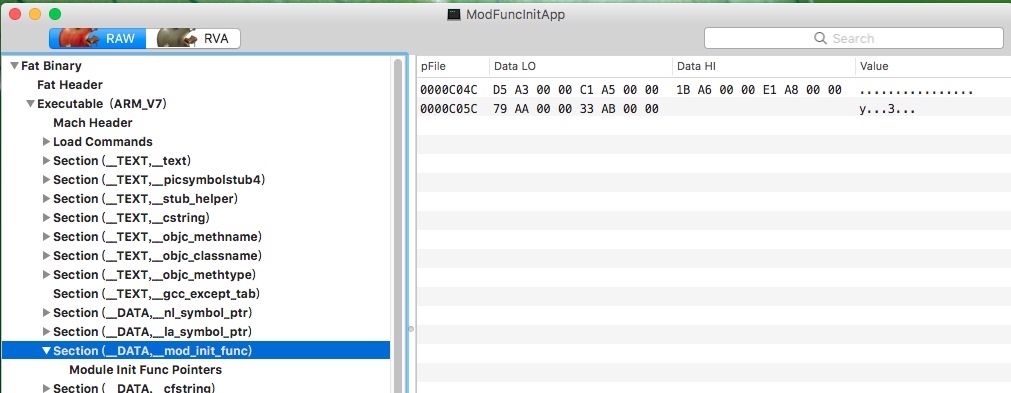
What Is This Section For?
From the name, we can roughly guess: module initializer functions—that’s about what it means.
In the dyld source code, you can find references to mod_init_func:
typedef void (*Initializer)(int argc, const char* argv[], const char* envp[], const char* apple[]);

extern const Initializer  inits_start  __asm("section$start$__DATA$__mod_init_func");
extern const Initializer  inits_end    __asm("section$end$__DATA$__mod_init_func");


static void runDyldInitializers(const struct macho_header* mh, intptr_t slide, int argc, const char* argv[], const char* envp[], const char* apple[])
{
	for (const Initializer* p = &inits_start; p < &inits_end; ++p) {
		(*p)(argc, argv, envp, apple);
	}
}
Note carefully: when debugging, you’ll find that dyld does NOT execute all Initializers by calling runDyldInitializers; instead, it executes them via void ImageLoaderMachO::doModInitFunctions(const LinkContext& context). But the code above, found on a first search, gives us a rough impression of mod_init_func.
From other materials, we can learn that there are many ways for code to produce a corresponding Initializer.
What Are the Ways to Produce an Initializer?
1. __attribute((constructor))
__attribute__((constructor)) void myentry(){
    NSLog(@"constructor");
}
2. Global Variable Initialization That Needs to Execute Code
This is mainly for C++ (or Objective-C++): source file extensions are .cpp, .cxx, or .mm. The global variables mentioned here include both those modified by static (scope limited to the current file) and those not modified by static.
If global variable initialization involves the following cases, a corresponding entry will be produced in mod_init_func:
(1) Need to execute a C function
bool initBar(){
    int i = 0;
    ++i;
    return i == 1;
}

static bool globalBar = initBar();
bool globalBar2 = initBar();
(2) Need to execute a C++ class constructor
class FooObject{
public:
    FooObject(){
        // do somthing
        NSLog(@"in fooobject");
    }

};

static FooObject globalObj = FooObject();
FooObject globalObj2 = FooObject();
(3) Need to construct an Objective-C object
static NSDictionary * dictObject = @{@"one":@"1"};
NSDictionary * dictObject2 = @{@"one":@"1", @"two":@"2"};
(4) A struct, for C++, can also be considered a kind of class
This code actually executes CGRect’s constructor—very sneaky~ hard to guard against~
CGRect globalRect = CGRectZero;
(5) Indirectly causing a function to run
The code below indirectly causes the description method to run when initializing globalArray.
NSString *description(const char *str){
    return [NSString stringWithFormat:@"hello %s",str];
}

#define E(str) description(str)


NSString* globalArray[] = {
    E("hello"),
    E("hello"),
    E("hello"),
    E("hello"),
    E("hello"),
    E("hello"),
};

NSString *globalString = E("world");
(6) Others
There are all kinds of other postures too.
Why Care About These
Since most iOS Apps today just use static libraries, large amounts of third-party or internal C++ code need to be statically linked. The code above indirectly increases the main program’s execution time before the main function.
If it’s a dynamic library loaded during the startup stage, this code still affects startup performance.
Look at the backtrace Again
Add a breakpoint and backtrace, and you can see dyld’s call stack:

Compiler Merging Pattern
All initializers in the same file automatically produce one Initializer, similar to handing all the initialization work in a file to a newly created function.
If you initialize a large number of global variables in one file, you’ll find that only one entry is ultimately produced in the mod_init_func section. And the symbol for this entry looks like this:
frame #3: 0x00000001000b8854 ModFuncInitApp`_GLOBAL__sub_I_TestClass.mm + 24 at TestClass.mm:0
It’s like a function named _GLOBAL__sub_I_TestClass.mm was generated.
How to Hook—First Find the Call Source
First, look at the call source:
(lldb) bt
* thread #1: tid = 0x47250, 0x00000001000b87c8 ModFuncInitApp`FooObject::FooObject(this=0x00000001000bd2d8) + 20 at TestClass.mm:15, queue = 'com.apple.main-thread', stop reason = breakpoint 1.1
  * frame #0: 0x00000001000b87c8 ModFuncInitApp`FooObject::FooObject(this=0x00000001000bd2d8) + 20 at TestClass.mm:15
    frame #1: 0x00000001000b879c ModFuncInitApp`FooObject::FooObject(this=0x00000001000bd2d8) + 28 at TestClass.mm:13
    frame #2: 0x00000001000b8804 ModFuncInitApp`::__cxx_global_var_init() + 24 at TestClass.mm:20
    frame #3: 0x00000001000b8854 ModFuncInitApp`_GLOBAL__sub_I_TestClass.mm + 24 at TestClass.mm:0
    frame #4: 0x00000001000b93e8 ModFuncInitApp`myInitFunc_Initializer(argc=1, argv=0x000000016fd4bab8, envp=0x000000016fd4bac8, apple=0x000000016fd4bb48, vars=0x00000001001d9918) + 140 at hook_cpp_init.mm:64
    frame #5: 0x00000001001bd95c dyld`ImageLoaderMachO::doModInitFunctions(ImageLoader::LinkContext const&) + 372
    frame #6: 0x00000001001bdb84 dyld`ImageLoaderMachO::doInitialization(ImageLoader::LinkContext const&) + 36
    frame #7: 0x00000001001b8f2c dyld`ImageLoader::recursiveInitialization(ImageLoader::LinkContext const&, unsigned int, char const*, ImageLoader::InitializerTimingList&, ImageLoader::UninitedUpwards&) + 368
    frame #8: 0x00000001001b7f50 dyld`ImageLoader::processInitializers(ImageLoader::LinkContext const&, unsigned int, ImageLoader::InitializerTimingList&, ImageLoader::UninitedUpwards&) + 140
    frame #9: 0x00000001001b8004 dyld`ImageLoader::runInitializers(ImageLoader::LinkContext const&, ImageLoader::InitializerTimingList&) + 84
    frame #10: 0x00000001001aa488 dyld`dyld::initializeMainExecutable() + 220
    frame #11: 0x00000001001ae8f4 dyld`dyld::_main(macho_header const*, unsigned long, int, char const**, char const**, char const**, unsigned long*) + 3892
    frame #12: 0x00000001001a9044 dyld`_dyld_start + 68
From the stack, you can see that dyld’s doModInitFunctions calls the Initializer in each file. Find this function in the dyld source code:
void ImageLoaderMachO::doModInitFunctions(const LinkContext& context)
{
if ( fHasInitializers ) {
const uint32_t cmd_count = ((macho_header*)fMachOData)->ncmds;
const struct load_command* const cmds = (struct load_command*)&fMachOData[sizeof(macho_header)];
const struct load_command* cmd = cmds;
for (uint32_t i = 0; i < cmd_count; ++i) {
if ( cmd->cmd == LC_SEGMENT_COMMAND ) {
const struct macho_segment_command* seg = (struct macho_segment_command*)cmd;
const struct macho_section* const sectionsStart = (struct macho_section*)((char*)seg + sizeof(struct macho_segment_command));
const struct macho_section* const sectionsEnd = §ionsStart[seg->nsects];
for (const struct macho_section* sect=sectionsStart; sect < sectionsEnd; ++sect) {
const uint8_t type = sect->flags & SECTION_TYPE;
if ( type == S_MOD_INIT_FUNC_POINTERS ) {
Initializer* inits = (Initializer*)(sect->addr + fSlide);
const size_t count = sect->size / sizeof(uintptr_t);
for (size_t i=0; i < count; ++i) {
Initializer func = inits[i];
// <rdar://problem/8543820&9228031> verify initializers are in image
if ( ! this->containsAddress((void*)func) ) {
dyld::throwf("initializer function %p not in mapped image for %s\n", func, this->getPath());
}
if ( context.verboseInit )
dyld::log("dyld: calling initializer function %p in %s\n", func, this->getPath());
func(context.argc, context.argv, context.envp, context.apple, &context.programVars);
}
}
}
}
cmd = (const struct load_command*)(((char*)cmd)+cmd->cmdsize);
}
}
}
Note these three lines:
Initializer* inits = (Initializer*)(sect->addr + fSlide);
Initializer func = inits[i];
func(context.argc, context.argv, context.envp, context.apple, &context.programVars);
You can see that each entry in mod_init_func is called as a function address, and the function type is Initializer. So let’s find the prototype of Initializer:
typedef void (*Initializer)(int argc, const char* argv[], const char* envp[], const char* apple[], const ProgramVars* vars);
Think About How to Hook
Since each address in mod_init_func is a function address, and they all have the same prototype, let’s find a way to replace all the addresses in mod_init_func with our own function address.
First, define our own function:
void myInitFunc_Initializer(int argc, const char* argv[], const char* envp[], const char* apple[], const struct MyProgramVars* vars){
    printf("my init func\n");

}
So the question is: how do we make dyld read our own myInitFunc_Initializer when it reads the data in mod_init_func?
(1) First, note that the __mod_init_func section is located in the __DATA segment. The __DATA segment is a data segment that can be modified at runtime.
(2) Second, we need to find a timing that is earlier than when dyld reads these Initializers.
When using Objective-C’s +load method, note that the documentation says this:
The order of initialization is as follows:

- All initializers in any framework you link to.
- All +load methods in your image.
- All C++ static initializers and C/C++ __attribute__(constructor) functions in your image.
- All initializers in frameworks that link to you.
+load methods actually run earlier. That makes it easy. In any +load method, find the in-memory address of the mod_init_func section after the process loads, and change all the data to the address of myInitFunc_Initializer.
How to Modify mod_init_func Data
Use the getsectiondata function to get the memory address of the mod_init_func section, then just modify it directly.
The code is as follows:
#ifndef __LP64__
    typedef uint32_t MemoryType;
#else /* defined(__LP64__) */
    typedef uint64_t MemoryType;
#endif /* defined(__LP64__) */

    Dl_info info;
    dladdr((const void *)hookModInitFunc, &info);

#ifndef __LP64__
    const struct mach_header *mhp = (struct mach_header*)info.dli_fbase;
    unsigned long size = 0;
    MemoryType *memory = (uint32_t*)getsectiondata(mhp, "__DATA", "__mod_init_func", & size);
#else /* defined(__LP64__) */
    const struct mach_header_64 *mhp = (struct mach_header_64*)info.dli_fbase;
    unsigned long size = 0;
    MemoryType *memory = (uint64_t*)getsectiondata(mhp, "__DATA", "__mod_init_func", & size);
#endif /* defined(__LP64__) */
    for(int idx = 0; idx < size/sizeof(void*); ++idx){
        MemoryType original_ptr = memory[idx];
        // 这里可以保存原来的地址

        memory[idx] = (MemoryType)myInitFunc_Initializer; // 替换为我们自己的Initializer
    }
How to Call the Original Initializer?
I thought about it over and over, but couldn’t come up with a way to add a method that records the corresponding original function address to myInitFunc_Initializer. Suddenly it occurred to me: don’t worry about the call order—just record all the original function addresses, and each time myInitFunc_Initializer is called, call the original functions one by one.
Let’s just look at the code.
static std::vector<MemoryType> *g_initializer; // 记录每一个原函数地址
static int g_cur_index;
Then, in our own Initializer, get each original function address one by one, call it and measure the time cost.
typedef void (*OriginalInitializer)(int argc, const char* argv[], const char* envp[], const char* apple[], const MyProgramVars* vars);

void myInitFunc_Initializer(int argc, const char* argv[], const char* envp[], const char* apple[], const struct MyProgramVars* vars){
    printf("my init func\n");

    ++g_cur_index;
    OriginalInitializer func = (OriginalInitializer)g_initializer->at(g_cur_index);

    CFTimeInterval start = CFAbsoluteTimeGetCurrent();

    func(argc,argv,envp,apple,vars);

    CFTimeInterval end = CFAbsoluteTimeGetCurrent();
}
ASLR
Because of ASLR, we can’t just record the function address—we also need to record the ASLR address. This is used later to locate the function address via the symbol file.
The ASLR offset (more precisely, the base address after the ASLR offset—thanks to Joy__ for pointing this out) is the variable mhp in the code above (i.e., the dli_fbase of mach_header_64).
The Fluctuating Log Is Out—Now How to Locate the File?
With the symbol file, put the app file and the dsym in the same directory, and you can locate the file.
atos -o Demo.app/Demo 0x100a1a47c -l 0x100018000

_GLOBAL__sub_I_XXXXX.cpp (in Demo) + 1
For details, refer to this article:
- http://www.jamiegrove.com/software/fixing-bugs-using-os-x-crash-logs-and-atos-to-symbolicate-and-find-line-numbers or
- https://xnu.app/2015/09/09/ios-plcrashreporter#dsym
Code
https://github.com/everettjf/Yolo/tree/master/HookCppInitilizers
Summary
Locating it is indeed cumbersome, but using this method you can locate, from the logs, those Initializers that fluctuate significantly in time cost during real App usage.
Each Initializer takes very little time, but over the long term, all kinds of Initializers that don’t need to run during the App’s startup stage have crept in silently. The power of the masses is great.
文章目录
先补充:标题中 static initializers 其实应该叫做 C++ static initializers and C/C++ __attribute__(constructor) functions。
使用 MachOView 打开一个MachO文件,多数情况下会看到这个section __mod_init_func 。
这个section的用途是什么呢?
从名字大概猜测,module initializer functions,模块初始化函数,大概就是这个意思。
从dyld的源码中可以找到mod_init_func相关字样:
typedef void (*Initializer)(int argc, const char* argv[], const char* envp[], const char* apple[]);

extern const Initializer  inits_start  __asm("section$start$__DATA$__mod_init_func");
extern const Initializer  inits_end    __asm("section$end$__DATA$__mod_init_func");


static void runDyldInitializers(const struct macho_header* mh, intptr_t slide, int argc, const char* argv[], const char* envp[], const char* apple[])
{
	for (const Initializer* p = &inits_start; p < &inits_end; ++p) {
		(*p)(argc, argv, envp, apple);
	}
}
注意注意:调试时会发现,dyld并没有通过调用 runDyldInitializers 来执行所有Initializer,而是通过 void ImageLoaderMachO::doModInitFunctions(const LinkContext& context) 来执行的。但上面的代码在首次搜索时,可以让我们对mod_init_func有个大概的印象。
通过其他资料,可以知道有很多途径可以让代码产生对应的一个Initializer。
有哪些方法可以产生Initializer?
1. __attribute((constructor))
__attribute__((constructor)) void myentry(){
    NSLog(@"constructor");
}
2. 全局变量的初始化需要执行代码
这里主要是对于C++来说(或者Objective C++)源文件扩展名是.cpp .cxx 或.mm 。这里说的全局变量包括static修饰的作用域仅在当前文件的,也包括不被static修饰的。
全局变量的初始化如果涉及以下情况,则会在mod_init_func中产生对应的条目:
(1)需要执行C函数
bool initBar(){
    int i = 0;
    ++i;
    return i == 1;
}

static bool globalBar = initBar();
bool globalBar2 = initBar();
(2)需要执行C++类的构造函数
class FooObject{
public:
    FooObject(){
        // do somthing
        NSLog(@"in fooobject");
    }

};

static FooObject globalObj = FooObject();
FooObject globalObj2 = FooObject();
(3)需要构造Objective-C 类
static NSDictionary * dictObject = @{@"one":@"1"};
NSDictionary * dictObject2 = @{@"one":@"1", @"two":@"2"};
(4)struct对于C++来说也可以说是一种类
这种代码其实就执行了CGRect的构造函数,很隐蔽呀~防不胜防啊~
CGRect globalRect = CGRectZero;
(5)间接导致运行函数
下面的代码间接导致了初始化globalArray时运行了description方法。
NSString *description(const char *str){
    return [NSString stringWithFormat:@"hello %s",str];
}

#define E(str) description(str)


NSString* globalArray[] = {
    E("hello"),
    E("hello"),
    E("hello"),
    E("hello"),
    E("hello"),
    E("hello"),
};

NSString *globalString = E("world");
(6)其他
还有各式各样其他的姿势。
为什么要关注这些
由于目前iOS App多数都只是在使用静态库,大量第三方或内部C++写的代码需要静态链接,上面这些代码间接增加了主程序在main函数之前的执行时间。
如果是动态库,且是启动阶段加载,那这些代码依然对启动性能有影响。
再看backtrace
加断点后backtrace,可以看到dyld的调用堆栈:
编译器合并规律
同一个文件中的所有initializer会自动产生一个Initializer,类似于把一个文件中的所有初始化工作交给一个新创建的函数。
如果在一个文件中初始化大量的全局变量,可以发现:最终在mod_init_func段中只产生了一项。而且这一项的符号是下面这样:
frame #3: 0x00000001000b8854 ModFuncInitApp`_GLOBAL__sub_I_TestClass.mm + 24 at TestClass.mm:0
类似于生成了一个 名称是 _GLOBAL__sub_I_TestClass.mm 的函数。
如何 Hook,先找调用来源
先看调用来源,
(lldb) bt
* thread #1: tid = 0x47250, 0x00000001000b87c8 ModFuncInitApp`FooObject::FooObject(this=0x00000001000bd2d8) + 20 at TestClass.mm:15, queue = 'com.apple.main-thread', stop reason = breakpoint 1.1
  * frame #0: 0x00000001000b87c8 ModFuncInitApp`FooObject::FooObject(this=0x00000001000bd2d8) + 20 at TestClass.mm:15
    frame #1: 0x00000001000b879c ModFuncInitApp`FooObject::FooObject(this=0x00000001000bd2d8) + 28 at TestClass.mm:13
    frame #2: 0x00000001000b8804 ModFuncInitApp`::__cxx_global_var_init() + 24 at TestClass.mm:20
    frame #3: 0x00000001000b8854 ModFuncInitApp`_GLOBAL__sub_I_TestClass.mm + 24 at TestClass.mm:0
    frame #4: 0x00000001000b93e8 ModFuncInitApp`myInitFunc_Initializer(argc=1, argv=0x000000016fd4bab8, envp=0x000000016fd4bac8, apple=0x000000016fd4bb48, vars=0x00000001001d9918) + 140 at hook_cpp_init.mm:64
    frame #5: 0x00000001001bd95c dyld`ImageLoaderMachO::doModInitFunctions(ImageLoader::LinkContext const&) + 372
    frame #6: 0x00000001001bdb84 dyld`ImageLoaderMachO::doInitialization(ImageLoader::LinkContext const&) + 36
    frame #7: 0x00000001001b8f2c dyld`ImageLoader::recursiveInitialization(ImageLoader::LinkContext const&, unsigned int, char const*, ImageLoader::InitializerTimingList&, ImageLoader::UninitedUpwards&) + 368
    frame #8: 0x00000001001b7f50 dyld`ImageLoader::processInitializers(ImageLoader::LinkContext const&, unsigned int, ImageLoader::InitializerTimingList&, ImageLoader::UninitedUpwards&) + 140
    frame #9: 0x00000001001b8004 dyld`ImageLoader::runInitializers(ImageLoader::LinkContext const&, ImageLoader::InitializerTimingList&) + 84
    frame #10: 0x00000001001aa488 dyld`dyld::initializeMainExecutable() + 220
    frame #11: 0x00000001001ae8f4 dyld`dyld::_main(macho_header const*, unsigned long, int, char const**, char const**, char const**, unsigned long*) + 3892
    frame #12: 0x00000001001a9044 dyld`_dyld_start + 68
通过堆栈,能看到 dyld 的 doModInitFunctions 会调用每个文件中的Initializer。从dyld的源码中找到这个函数:
void ImageLoaderMachO::doModInitFunctions(const LinkContext& context)
{
if ( fHasInitializers ) {
const uint32_t cmd_count = ((macho_header*)fMachOData)->ncmds;
const struct load_command* const cmds = (struct load_command*)&fMachOData[sizeof(macho_header)];
const struct load_command* cmd = cmds;
for (uint32_t i = 0; i < cmd_count; ++i) {
if ( cmd->cmd == LC_SEGMENT_COMMAND ) {
const struct macho_segment_command* seg = (struct macho_segment_command*)cmd;
const struct macho_section* const sectionsStart = (struct macho_section*)((char*)seg + sizeof(struct macho_segment_command));
const struct macho_section* const sectionsEnd = §ionsStart[seg->nsects];
for (const struct macho_section* sect=sectionsStart; sect < sectionsEnd; ++sect) {
const uint8_t type = sect->flags & SECTION_TYPE;
if ( type == S_MOD_INIT_FUNC_POINTERS ) {
Initializer* inits = (Initializer*)(sect->addr + fSlide);
const size_t count = sect->size / sizeof(uintptr_t);
for (size_t i=0; i < count; ++i) {
Initializer func = inits[i];
// <rdar://problem/8543820&9228031> verify initializers are in image
if ( ! this->containsAddress((void*)func) ) {
dyld::throwf("initializer function %p not in mapped image for %s\n", func, this->getPath());
}
if ( context.verboseInit )
dyld::log("dyld: calling initializer function %p in %s\n", func, this->getPath());
func(context.argc, context.argv, context.envp, context.apple, &context.programVars);
}
}
}
}
cmd = (const struct load_command*)(((char*)cmd)+cmd->cmdsize);
}
}
}
注意看这三句:
Initializer* inits = (Initializer*)(sect->addr + fSlide);
Initializer func = inits[i];
func(context.argc, context.argv, context.envp, context.apple, &context.programVars);
可以看到mod_init_func中的每一项,都作为一个函数地址调用,函数类型是 Initializer。那我们找到 Initializer 的原型:
typedef void (*Initializer)(int argc, const char* argv[], const char* envp[], const char* apple[], const ProgramVars* vars);
想想如何hook
既然mod_init_func中的每个地址都是一个函数地址,且原型也都是一样的。那我们就想办法把mod_init_func中的所有地址都替换为我们自己的函数地址。
先定义一个自己的函数:
void myInitFunc_Initializer(int argc, const char* argv[], const char* envp[], const char* apple[], const struct MyProgramVars* vars){
    printf("my init func\n");

}
那么问题来了,如何让dyld在读取mod_init_func中的数据时,读到的是我们自己的myInitFunc_Initializer呢?
(1)首先,注意到 __mod_init_func section 位于 __DATA segment。__DATA segment是数据段,是可以在运行时修改的。
(2)其次,就是找个时机,要早于dyld读取这些Initializer。
平时在使用Objective C的+load方法时,注意到文档这么写:
The order of initialization is as follows:

- All initializers in any framework you link to.
- All +load methods in your image.
- All C++ static initializers and C/C++ __attribute__(constructor) functions in your image.
- All initializers in frameworks that link to you.
+load methods 竟然要更早。那就好办了。在任意一个+load方法中找到进程加载后,mod_init_func段在内存中的地址,把数据都改为 myInitFunc_Initializer 的地址。
如何修改mod_init_func数据
使用 getsectiondata 函数可以获取mod_init_func段的内存地址,直接修改就行了。
代码如下:
#ifndef __LP64__
    typedef uint32_t MemoryType;
#else /* defined(__LP64__) */
    typedef uint64_t MemoryType;
#endif /* defined(__LP64__) */

    Dl_info info;
    dladdr((const void *)hookModInitFunc, &info);

#ifndef __LP64__
    const struct mach_header *mhp = (struct mach_header*)info.dli_fbase;
    unsigned long size = 0;
    MemoryType *memory = (uint32_t*)getsectiondata(mhp, "__DATA", "__mod_init_func", & size);
#else /* defined(__LP64__) */
    const struct mach_header_64 *mhp = (struct mach_header_64*)info.dli_fbase;
    unsigned long size = 0;
    MemoryType *memory = (uint64_t*)getsectiondata(mhp, "__DATA", "__mod_init_func", & size);
#endif /* defined(__LP64__) */
    for(int idx = 0; idx < size/sizeof(void*); ++idx){
        MemoryType original_ptr = memory[idx];
        // 这里可以保存原来的地址

        memory[idx] = (MemoryType)myInitFunc_Initializer; // 替换为我们自己的Initializer
    }
怎么调用原来的Initializer?
想来想去,没想到办法给myInitFunc_Initializer增加记录对应的原函数地址的方法。突然一想,不用管调用顺序,把所有的原函数地址记录下来,然后每调用一次 myInitFunc_Initializer 就逐个调用原函数就行了。
还是看代码吧。
static std::vector<MemoryType> *g_initializer; // 记录每一个原函数地址
static int g_cur_index;
然后,在自己的Initializer中逐个获取每一个原函数地址,调用并计算耗时。
typedef void (*OriginalInitializer)(int argc, const char* argv[], const char* envp[], const char* apple[], const MyProgramVars* vars);

void myInitFunc_Initializer(int argc, const char* argv[], const char* envp[], const char* apple[], const struct MyProgramVars* vars){
    printf("my init func\n");

    ++g_cur_index;
    OriginalInitializer func = (OriginalInitializer)g_initializer->at(g_cur_index);

    CFTimeInterval start = CFAbsoluteTimeGetCurrent();

    func(argc,argv,envp,apple,vars);

    CFTimeInterval end = CFAbsoluteTimeGetCurrent();
}
ASLR
由于ASLR的存在,不能只记录函数的地址,还需要记录ASLR的地址。用于后续通过符号文件定位出函数地址。
ASLR偏移(准确的说是,ASLR偏移后的基地址,感谢 Joy__指出)就是上面代码中的变量 mhp(也就是 mach_header_64 的dli_fbase)。
浮动的日志出来了,怎么再定位到文件?
有了符号文件,把app文件和dsym放在同一个目录下,就可以定位到文件啦。
atos -o Demo.app/Demo 0x100a1a47c -l 0x100018000

_GLOBAL__sub_I_XXXXX.cpp (in Demo) + 1
详细参考这篇文章
- http://www.jamiegrove.com/software/fixing-bugs-using-os-x-crash-logs-and-atos-to-symbolicate-and-find-line-numbers 或者
- https://xnu.app/2015/09/09/ios-plcrashreporter#dsym
代码
https://github.com/everettjf/Yolo/tree/master/HookCppInitilizers
总结
定位起来确实麻烦,但使用这个方法能从日志中定位到真实使用App的过程中那些耗时浮动较大的Initializer。
每个Initializer都耗时很少,但长期以来,各种不需要在App启动阶段执行的Initializer都悄无声息的进来了。群众的力量大啊。